
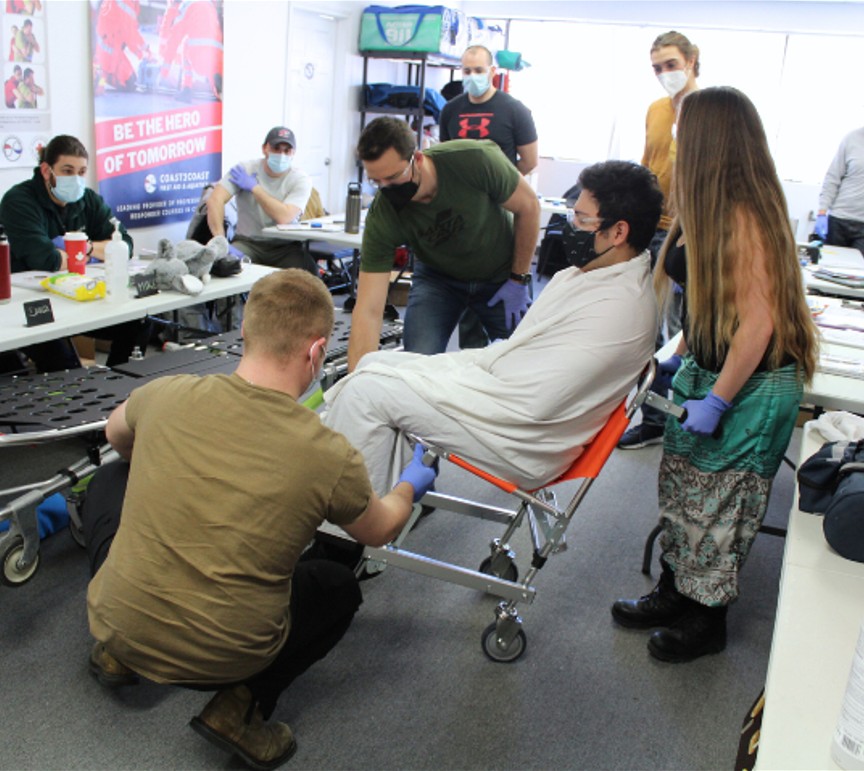
Think about what happens in your shop on any given day. Sharp tools. Standing for hours. Clients who haven’t eaten, who are elderly, who have undisclosed health conditions. You’re a skilled barber — but are you ready if someone collapses in your chair? If you’re in Newmarket, Coast2Coast First Aid Newmarket offers certification courses designed to fit around real work schedules, so there’s no good reason to put it off.
What Could Actually Go Wrong in a Barber Shop?
More than you might think. A client fainting isn’t rare — dehydration, low blood pressure, and anxiety reactions happen in service environments all the time. Cuts that bleed more than expected. A colleague who nicks an artery with a straight razor. An elderly client whose heart goes into an irregular rhythm mid-haircut.
None of these scenarios are dramatic. They’re just Tuesday.
The difference between a bad outcome and a manageable one is usually ten minutes and someone who knows what to do. That’s what first aid training gives you.
Isn’t That What 911 Is For?
Yes — and you should absolutely call. But here’s the problem: emergency response times in Ontario average between eight and twelve minutes in many suburban areas. A person experiencing cardiac arrest loses roughly ten percent of their survival odds for every minute that passes without intervention. CPR and an AED can bridge that gap.
Waiting for paramedics without doing anything isn’t neutral. It’s a choice with consequences.
First aid training teaches you how to respond in those first critical minutes — not to replace the ambulance, but to buy time until it arrives. That’s a skill that belongs in every shop.
What Does Ontario Law Say?
Under the Ontario Occupational Health and Safety Act (OHSA), employers have a legal duty to ensure their workplaces are prepared to respond to injuries and medical emergencies. While a solo chair rental may not require a designated first aider the way a large manufacturing floor does, the spirit of the regulation is clear: workplaces are responsible for the people in them.
More practically, your shop insurance, your landlord, and increasingly your clients care about whether you’ve taken basic safety steps. A certificate is evidence that you have.
WSIB coverage considerations aside, having documented first aid training is one of those things that costs you almost nothing and matters enormously the one time you need it.
Which Course Do Barbers Actually Need?
Most barbers and shop owners need, at minimum, CPR Level C with AED — this covers adult, child, and infant resuscitation, which matters when clients bring kids in. If you want broader coverage, Standard First Aid adds wound management, shock response, and injury assessment.
Neither course takes more than a day or two. Both are offered in blended learning format — meaning you complete the theory portion online at your own pace and come in for the hands-on skills session. For someone who works irregular hours or runs their own shop, that flexibility matters.
BLS (Basic Life Support) is worth considering if you employ staff with any health background, work near a clinic, or simply want the most thorough certification available.
What About Shop Staff?
If you have even one other person working in your space — another barber, a receptionist, a shampoo assistant — it’s worth getting them certified too. Not just for compliance reasons. If you’re the one who goes down, someone else needs to be able to help.
A team where two or three people hold current certificates is a fundamentally safer environment than a shop where one person has a laminated card from six years ago. Certifications expire, skills fade. Keeping current matters.
Coast2Coast First Aid & Aquatics makes it easy for small teams to book group sessions — which can work out to significantly less per person than individual registrations.
Does It Make Business Sense?
Put it this way: a first aid certificate costs less than a single slow Saturday. It takes one to two days. And it communicates something to your clients that a Instagram following and a sharp fade can’t — that you run a professional operation where people’s safety is taken seriously.
More clients are paying attention to this than barbers realize. Older clients especially. Parents bringing in their kids. Corporate clients who spend the week in boardrooms where safety culture is assumed. Being the shop that takes this seriously is a genuine point of difference.
It’s also, frankly, the right thing to do.
How to Get Started
Look for a course that is Red Cross certified or Heart & Stroke approved — those are the two gold-standard certifying bodies in Canada. Make sure the provider offers blended learning so you’re not sitting in a classroom for a full day when you could be behind the chair.
If you are looking for first aid and CPR certification near Bayview Avenue, Davis Drive, or the Southlake Regional Health Centre area, you may reach out to Coast2Coast First Aid & Aquatics in Newmarket for scheduling and group booking options.
FAQS
Q: Do barbers in Ontario need first aid training by law? A: The Ontario OHSA requires employers to maintain a safe workplace and respond to emergencies. While specific first aider requirements depend on the number of workers and workplace classification, all employers — including shop owners — are expected to have basic emergency response capacity. Having current CPR and first aid certification is a practical way to meet that standard.
Q: How long does a first aid certification course take? A: CPR Level C with AED typically takes four to six hours for the in-person skills component, especially with blended learning where theory is completed online beforehand. A Standard First Aid course runs one to two days. Neither requires an extensive time commitment, and many providers offer weekend sessions.
Q: How often do I need to renew my first aid certification in Ontario? A: Standard First Aid certification is valid for three years in Ontario. CPR certification requires annual renewal. It’s good practice to keep a record of your certification date and set a reminder before it expires — letting it lapse means starting from scratch rather than taking a shorter recertification course.
Q: Can I book a group first aid course for my whole shop team? A: Yes. Many providers, including those in the Newmarket area, offer group sessions that can be scheduled for small teams. This is often more cost-effective than individual bookings and ensures your entire staff is trained at the same time, which simplifies your renewal tracking.
Q: What’s the difference between CPR Level C and Standard First Aid? A: CPR Level C covers cardiopulmonary resuscitation for adults, children, and infants, plus AED use. Standard First Aid includes everything in CPR Level C and adds training in wound care, shock management, bone and joint injuries, and other medical emergencies. For barbers, Standard First Aid offers broader coverage and is recommended for shop owners or anyone who manages others.