
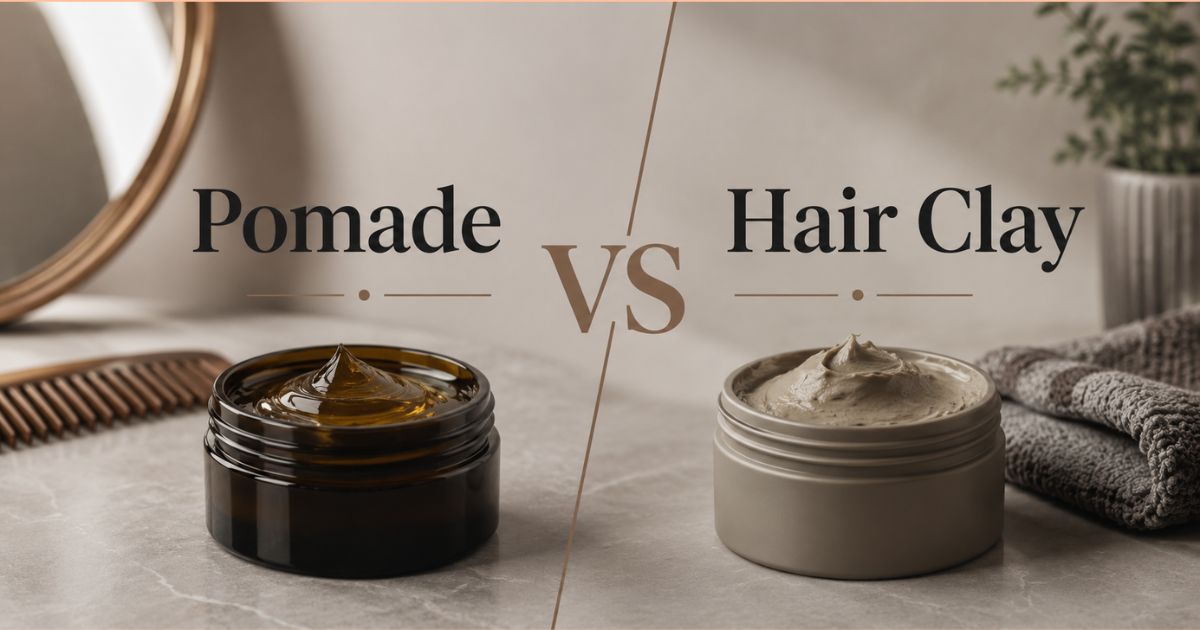
Most men use any styling product available without considering it. Next, they spend 10 minutes arguing about their hair in the mirror, wishing it wasn’t so bad by noon. In 9 out of 10 cases, it is not the technique. It is the product. Two of the most popular men’s styling products are pomade vs hair clay. They are very different in their use and designed for different ends.
This guide will help you to understand what makes them different, which one is the right one for your hair, and how to use them correctly to avoid any guesswork.
What Is Pomade?
Pomade has been around since the early days of barbering. It was the reason for all of the smooth back, pompadour and side part hairdos you’ve seen in vintage photos. Since then, the formula has changed, but the purpose has stayed the same: to smooth, shine and tame the hair.
There are two basic types of pomade today.
Most men use water-based pomade every day. Easy to apply, rinse off with normal shampoo and provides a light sheen to a full shine finish depending on the product used. It’s also workable all day long, which is part of its appeal.
The traditional formula is oil-based pomade. It can hold longer and will give you that old fashioned luster. The downside is that it requires a lot of effort to wash out and may accumulate on the scalp if it’s not used in conjunction with a clarifying shampoo.
The fundamental feature in both versions is that they polish and smooth the hair, creating an intentional look.
What Is Hair Clay?
Men started to go more natural, with a more textured appearance, rather than the shiny, over-groomed hairstyles that were common in barbershops, and hair clay has been in use ever since. It is a thickening agent that uses natural clay minerals, typically bentonite or kaolin. Clay is the only product on the shelf that contains these minerals.
Unlike pomade, clay will not coat the hair; it will adhere to each individual strand. This bonding effect provides grip, texture and shape, particularly in fine or thin hair where other products don’t work. The finish is matte, so that your hair won’t look like it’s been dipped in something.
Clay will set harder with the drying, and if you have a style, you don’t have to worry too much about it staying that way.
Pomade vs Hair Clay: Side-by-Side Comparison
| Feature | Hair Clay | Pomade |
| Finish | Matte to natural | Low sheen to high gloss |
| Hold Strength | Medium to strong | Medium to firm |
| Volume and Texture | Adds visible body and texture | Smooths and controls, no lift |
| Reworkability | Moderate, sets over time | High, especially water-based |
| Best for Fine Hair | Yes, builds thickness | No, it can weigh hair down |
| Best for Thick Hair | Yes, adds separation | Yes, controls and smooths |
| Washability | Easy, one shampoo pass | Easy (water-based), harder (oil-based) |
| Best Hairstyles | Textured crops, quiffs, messy styles | Slick backs, pompadours, side parts |
Finish: Matte vs Shine
This is where the two products differ the most.
The light does not reflect off of hair clay. The outcome is a natural, subtle look with hair appearing hair. No product is visible; no product is greasy; it is clean. This is a type of finish that is suitable for casual, professional, or anywhere in between.
Pomade reflects light. It can vary from a healthy, subtle sheen to a full wet look, depending on the formula. That shine is one of the elements that give classic hairstyles a sharp and defined look. It’s good for a more formal style and polished surroundings.
Clay is your product if you want to appear groomed without appearing like you put on a show. Pomade is the best option if you’re looking for a sharp, shiny look with a little shine.
Hold and Texture
The mineral content of clay forms a bond with single strands. The hold is tactile and firm, and maintains texture and separation throughout the day. Your hair remains in place, yet it is not crunchy and moves.
Pomade is used to hold the hair in place as a whole. It makes everything smooth and helps to direct the direction of the style. That is what classic looks, with direction, require, but it doesn’t provide any texture along the way.
Clay is the better option for fine or thin hair. It gives the added thickness at the roots and texture to the strands, creating the illusion of thickness. Pomade can pull hair back and may give a sparse look to fine hair.
Which Product Suits Your Hair Type?
Thin or fine hair: Hair clay. It adds volume and makes the hair look thicker, but it won’t weigh it down.
Thick hair: Both are good options. Clay separates and provides a lightness to the thickness. If you prefer a more sleek look, you can use Pomade to control and smooth.
Natural hair: Either product, based on the style. Clay is a great choice for adding dimension and texture to hair that has a flat appearance. Pomade can be used to add to the natural smoothness for a polished appearance.
Wavy hair: Clay is good at working with the wave and holds it naturally. Pomade helps to tame the wave and create a sleeker look.
Clay is more suitable for curly hair. It gives curls without the greasy feel of oil-based pomade.
Best Hairstyles for Each Product
- Hair Clay can be used on: Textured crops, messy quiffs, French crops, brush backs, faux hawks and any style that is intended to look easy and natural.
- Use pomade on: Slick backs, pompadours, sides, comb-overs, Ivy League, any style that requires clean lines and a polished appearance.
How to Apply Hair Clay

Use towel-dried hair. Clay requires a little bit of hold to work with, and wet hair strips out most of the texture and hold it has. Heat about the size of a dime between your palms until it is softened and slightly sticky. Distribute through hair from the back to the front. Use your fingers to shape the style. If you need it, add it, but don’t add too much clay, as it will make the hair heavy and clumpy.
How to Apply Pomade
Water-based pomade can be applied to wet or dry hair. Wet hair provides a natural and light look. Dry hair creates a more defined and shiny look. Oil-based pomade is best on totally dry hair.
Heat it in your hands and massage it into the hair in the direction of the hairstyle. If you want something classic such as side parts or slick backs, apply a comb to smooth the surface and set the part clearly. Begin light and gradually increase if necessary.
Is it possible to use both at the same time?
Yes, and it is good for some styles. Use clay to undercoat with grip and texture, and then lightly apply a water-based pomade on the top to give a controlled finish and smooth top. This is great for styles that fall somewhere in between textured and polished, such as a textured comb-over or a brushed-back quiff.
Reverse order is not allowed. If pomade is applied first, then the strands will be sealed, and the clay will not adhere, negating the benefits of using both.
Conclusion
There is no competition between pomade and hair clay. They have two different aims. Clay is the product to incorporate into your routine to add texture, body and a natural matte finish. Pomade is perfect for a classic, smooth and shiny finish, with good control.
The best method to determine which to use is to examine the style you’re going for and your natural hair. If you match the product with those two, you will have to spend a lot less time in a hair battle in the morning.
Frequently Asked Questions
For thin hair, is it better to use hair clay or hair pomade?
Clay for hair is the best choice for thin hair. The clay minerals give body and texture to the strands, giving the appearance of more volume. Pomade helps to smooth and flatten fine hair.
Does hair clay rinse out?
Yes. Most hair clay products can be easily removed with regular shampoo. Clay doesn’t stick to the scalp like oil-based pomade does, as it doesn’t contain petroleum or heavy wax. Water-based pomade can also be easily washed out, but the oil-based version of pomade may need a clarifying shampoo to remove completely.
Can I wear pomade every day?
Water-based pomade can be used every day. If you use it regularly, it can build up on the scalp if you don’t have a proper wash routine, so it’s good to incorporate a clarifying shampoo into your weekly wash routine.