
Anyone who has waited out a breakdown on the 215 in July knows the math isn’t complicated: a car that stalls in Las Vegas heat becomes a medical situation a lot faster than it would almost anywhere else. Pavement temperatures on the Strip can top 150 degrees on an August afternoon, and a dashboard thermometer reading 118 outside means the inside of a parked car with no AC climbs into triple digits within minutes.
Most drivers pack a flashlight and jumper cables and call it done. In this climate, that’s not enough. Anyone commuting the I-15 corridor, the 215 beltway, or surface streets like Sahara and Tropicana during rush hour needs to plan for the possibility of sitting stationary in traffic with the engine idling for twenty minutes at a time, on top of the usual risk of a straightforward breakdown. Here’s what actually belongs in the trunk if you’re driving Las Vegas streets and freeways on a regular basis, along with a few things worth knowing about your coverage before you ever need to use any of it.
Water Comes First, Not Last
A gallon per person, minimum, and rotate it every few months because heat degrades plastic bottles and the water inside starts to taste like it. Skip the temptation to keep bottled water in the trunk long-term during summer; trunk temperatures run even hotter than cabin temperatures, and repeated heat cycling breaks down the plastic. A soft-sided cooler with a couple of frozen water bottles works better than a case sitting in direct sun.
Electrolyte packets are worth the two dollars. Plain water helps, but if you’re stranded for even thirty minutes in July, sweating without replacing sodium and potassium is how a bad afternoon turns into a heat exhaustion call to 911.
The Non-Negotiable Mechanical Basics
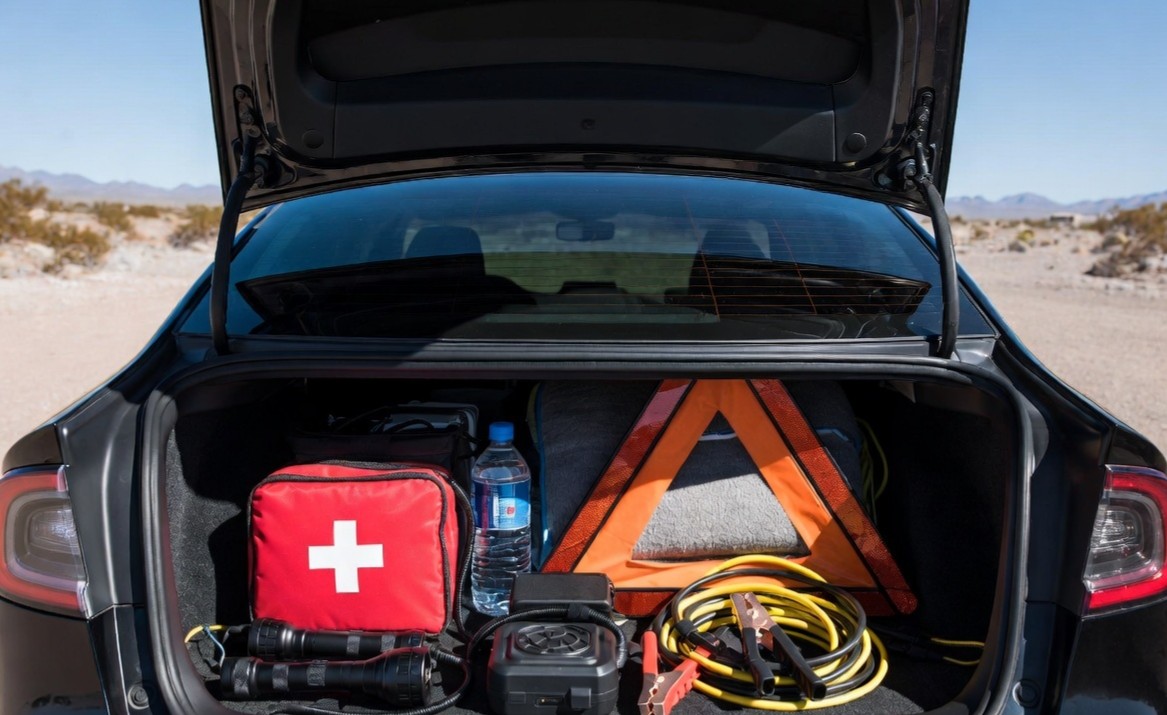
A portable jump starter beats old-fashioned cables because it doesn’t require flagging down a second car. That’s genuinely useful on a quiet stretch of the 215 at 2 a.m. Add a tire pressure gauge and a portable inflator; desert heat causes air inside tires to expand, and a tire that reads fine at 6 a.m. can be dangerously overinflated by 2 p.m., which raises blowout risk on the freeway. A basic tool kit, a reflective warning triangle or road flares, and a pair of work gloves round out the essentials. Gloves matter more here than in most places. Touching bare metal on a car that’s been sitting in the sun can actually burn skin.
Shade and Shelter Items People Forget
A cheap reflective windshield sunshade does more than keep the cabin cooler while you’re driving. If you break down, it’s the difference between waiting in a car that hits 130 degrees inside and one that stays survivable. Pack a physical umbrella or a portable sunshade you can prop against a window; standing next to a broken-down car on Boulder Highway with no shade for forty minutes in August is genuinely dangerous, not just uncomfortable.
A phone charger that doesn’t depend on the car battery, ideally a small power bank, matters more in Las Vegas than in cooler climates, since heat drains phone batteries faster and you may need a working phone longer while waiting for a tow truck during peak roadside-assistance demand in summer.
Documentation That Actually Helps
Keep a physical copy of your registration, proof of insurance, and a laminated card with your policy number and roadside assistance line in the glove box, not just a photo on your phone that dies with a hot battery. If you’re new to the valley or shopping around, it’s worth comparing car insurance quotes in Nevada before renewal season rather than after a breakdown, since local traffic density and the sheer number of tourist drivers unfamiliar with the roads push Las Vegas rates above the state average.
Nevada requires drivers to carry at least 25/50/20 in liability coverage: $25,000 in bodily injury per person, $50,000 per accident, and $20,000 in property damage. But most agents will tell you those minimums don’t go far if a serious accident happens on a packed freeway during rush hour. Given that roughly one in ten Nevada drivers is uninsured, it’s worth asking your agent about uninsured motorist coverage specifically, since Nevada insurers are required to offer it but you have to accept it in writing.
When a Rental or Borrowed Car Needs Coverage Too
Commuters who drive a friend’s car for a few weeks, or fly in for a Las Vegas job assignment and need wheels temporarily, often assume their regular policy or the rental company’s coverage has them covered. That’s not always true, and gaps show up exactly when something goes wrong. If you’re only going to be behind the wheel of a specific vehicle for a limited stretch, looking into short term car insurance before you drive it is a lot cheaper than discovering a coverage gap after a fender bender on Flamingo Road.
Building the Kit Without Overpacking
You don’t need everything on every “ultimate emergency kit” list circulating online. A realistic Las Vegas kit fits in a milk crate or a soft duffel and includes:
- A gallon of water per person, replaced seasonally
- Electrolyte packets or powder
- Portable jump starter and tire inflator
- Reflective sunshade and a small umbrella
- Phone power bank
- Basic first aid kit
- Work gloves and a reflective triangle
- Laminated insurance and registration copies
Skip the bulky items: full-size toolboxes, five-gallon water jugs, thick wool blankets meant for winter breakdowns in other states. None of that helps in a Mojave summer, and it just adds weight your AC has to fight against.
Why Tow Wait Times Change Your Math
A breakdown on I-95 in a residential neighborhood at 9 a.m. is a different problem than one on the Strip during a major event weekend. Tow companies in Las Vegas routinely see wait times stretch past an hour when a convention, a fight weekend, or a festival is pulling traffic and roadside assistance crews toward Paradise Road and the resort corridor. That gap matters more here than in a city where summer temperatures top out in the 80s. An hour is a long time to sit in a hot car, which is exactly why the shade and hydration items above aren’t optional extras. They’re what gets you through the wait rather than what’s left over once you’ve bought the more obvious gear.
It also means calling for a tow the moment you suspect trouble, rather than waiting to see if the noise goes away, is worth the minor inconvenience of a false alarm. Getting into the queue early beats discovering you’re forty-fifth in line after the car has already stopped running.
A Few Habits That Matter as Much as the Kit
Check your tire tread and coolant levels monthly during summer, not just before road trips. Heat accelerates wear on rubber components and hoses, and a coolant system that’s borderline in April can fail outright by July. The National Highway Traffic Safety Administration recommends inspecting wiper blades, belts, and hoses before hot weather sets in, since rubber parts degrade faster in high heat even on vehicles that otherwise run fine.
If your car does break down on a Las Vegas freeway, get everyone out and away from traffic before doing anything else. More people are hurt standing near a disabled vehicle than by the breakdown itself. Turn on hazards, set up a triangle or flares if you can do so safely, and call for help before you start troubleshooting the actual problem.
None of this is complicated. It just requires treating summer driving here as its own category, separate from whatever worked in a place with actual seasons.