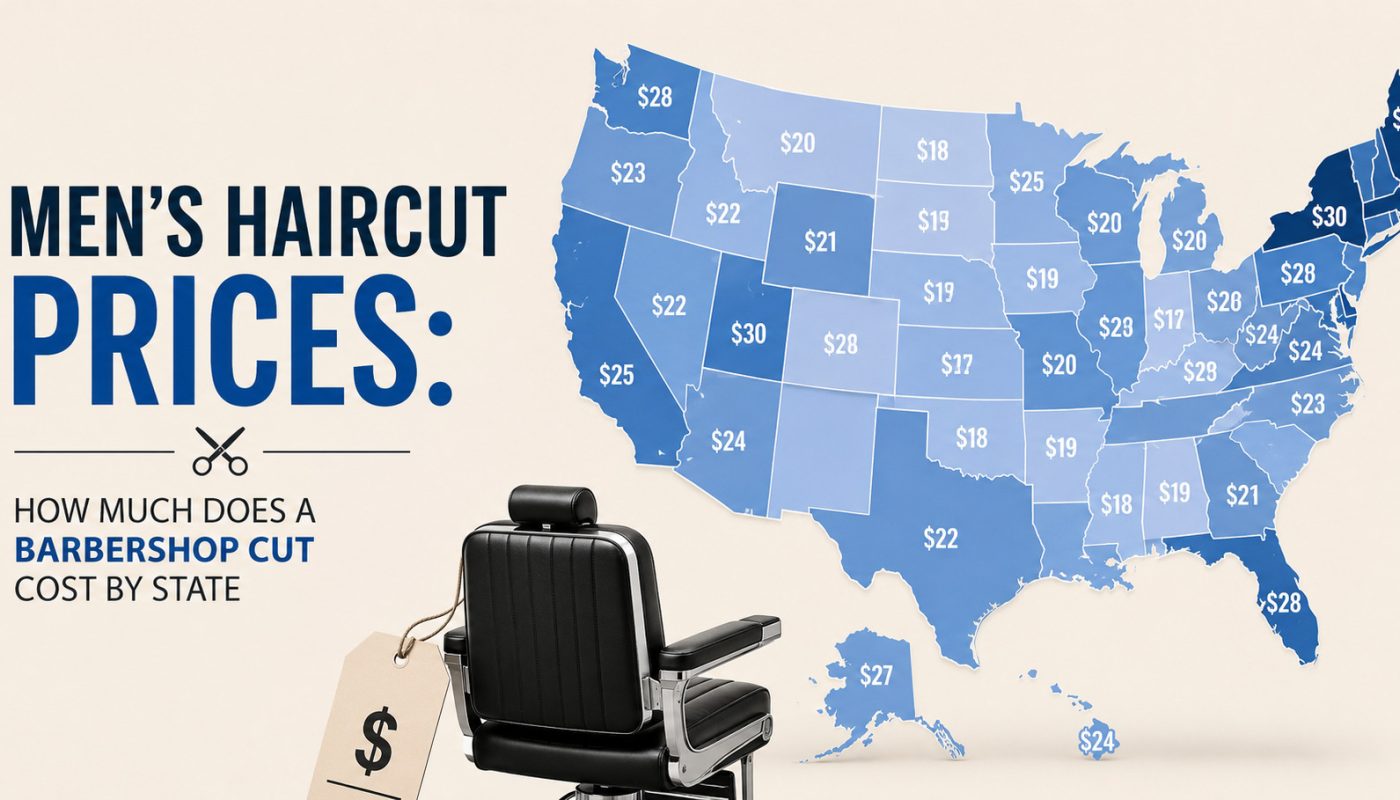
Has there ever been a time when you’ve moved to a new place or travelled for work, when you noticed that your haircut budget was gone? You spend $30 on a cut at home, and $50 on one elsewhere. It’s not in your imagination. Men’s haircut prices vary more than you might think, and for good reason, which reveals a lot about the nature of the business of barbering.
This guide explains what men are paying nationwide, why the figures vary widely from state to state, and how to determine if you’re getting a good deal at your own barbershop.
The National Average For A Men’s Haircut
In the USA, a typical men’s haircut at a barbershop is between 25 and 45 dollars, and the national average is around 35 to 40 dollars. This includes the basic cut using clippers or scissors, and typically does not include a beard cut, hot towel, or styling products.
Chain salons such as Great Clips or Supercuts will usually be on the lower end, ranging from 15 to 28 dollars. Independent barbershops are in the middle. Men’s hairstyling salons and lounges that offer longer or more elaborate cuts may cost anywhere from 50 to 90 dollars, and in a few big cities, even more.
Why Prices Vary So Much By State
Most of the difference in costs between Ohio and New York can be attributed to a few factors.
Cost Of Living And Rent
In high-priced cities, the price of the barbershop chairs is higher. Commercial space rent in Manhattan or San Francisco is nothing like a shop owner’s rent in Kansas or Alabama. This overhead is transferred into the cost of each cut.
Licensing And Regulation
The requirements for barber licensing vary from state to state, and some states require more hours of training than others. Average prices are slightly higher in states with higher requirements and higher renewal fees because barbers have to make up that expense somewhere.
Local Demand And Culture
In urban areas where grooming is a regular practice as opposed to a one-time task, barbers may charge more for skin tapers, detailed fades, and beard work. Higher prices are more likely to be maintained in areas where a haircut is still considered a functional service.
Barber Experience
The more experienced a barber is, with 10 years of experience and a loyal following, the more he can charge, no matter how he’s feeling. It is true everywhere, but is more evident in competitive markets where clients will pay for a particular individual instead of any chair.
Average Men’s Haircut Prices By Region
Here is a general breakdown of what men are typically paying at independent barbershops across different parts of the country. These are standard ranges for a basic haircut and do not include tips or add-on services.
| Region | Typical Price Range | Notes |
| Northeast (NY, NJ, MA, CT) | $35 to $70 | Major cities like New York push well above this range |
| Mid Atlantic (PA, MD, VA, DE) | $30 to $50 | Philadelphia and DC run on the higher end |
| Southeast (GA, FL, NC, SC, TN) | $25 to $45 | Growing cities like Atlanta and Nashville are catching up to national averages |
| Midwest (OH, IN, IL, MI, WI) | $20 to $35 | Generally the most affordable region in the country |
| South Central (TX, OK, LA, AR) | $25 to $45 | Prices vary widely between rural towns and cities like Austin |
| Mountain West (CO, UT, ID, MT, WY) | $25 to $40 | Denver trends higher than smaller mountain towns |
| Pacific (CA, WA, OR) | $30 to $65 | Coastal cities carry some of the highest prices in the country |
| Hawaii and Alaska | $40 to $60 | Shipping and cost of living push prices up |
These ranges reflect a standard cut. Fades, skin tapers, and design work usually add 5 to 15 dollars to the base price, and beard trims typically run another 10 to 20 dollars.
What This Means If You Run A Barbershop
For owners and managers of shops, it is not very informative to compare prices with a national figure. The important thing is your particular city and neighborhood. Downtown Austin is not competing with downtown Arkansas.
A more effective way is to search three to four bars in a 5-mile area and find out what they charge for a basic cut, and then determine where you will be based on your experience level and the kind of clients you wish to attract. It’s not always best to undercut your competition. It can make it more difficult to raise the price later, and if you have great work, it can be a sign of lower quality to prospective clients.
What This Means If You’re A Client
If you’re wondering if you’re overcharging, first look at a couple of stores in your area instead of comparing your bill to a national average you’ve seen online. A 45 dollar cut in San Francisco is not too expensive; it’s the same with a 45 dollar cut in a small town in the middle of the country. The true factor in what a fair price is depends on the location, not only the skill.
Conclusion
Men’s haircut costs are not arbitrary, even if they appear to be. It’s not just rent and licensing that affect the price, though; local demand and barber experience also have an impact, and this varies from state to state and city to city. If you’re a client seeking to budget your next cut or a barber aiming to set fair prices, it’s best to check your local market rather than just a national number.
The prices will always differ from state to state, but with a little understanding of the situation, it can be a lot less confusing.
Frequently Asked Questions
How is it that haircuts are more expensive in certain cities than others?
This is primarily a matter of rent, cost of living, and local demand. In a high-cost city, barbers will have higher overheads and will need to mark up their prices accordingly, if not to cover costs.
Do you have to tip over the top of the hairstyle price?
Yes. Most clients pay from 15 to 20 per cent, as they do at a restaurant. Some men pay a fixed fee for a job well done, particularly if they have a regular barber.
Are beards and fades priced differently in all places?
In most shops, yes. Typical haircut services typically involve only the hair, while additional services such as beard trims, line-ups, or intricate fade work are billed separately or as part of a slightly increased package price.