The Caesar has been around for hundreds of years, and yet it’s there in barbershops every day. There’s a reason for that. It is one of the few styles that can be worn by almost all hair types, requires minimal upkeep, and looks sharp regardless of whether you are going to work or going out for the weekend.
If you are thinking about cutting a tree, or you have an existing tree and want to do more with it, this guide will take you through it. We’ll discuss what the cut is, the most popular cuts, how to request the cut from your barber, and how to maintain it between visits.
What is a Caesar Haircut?
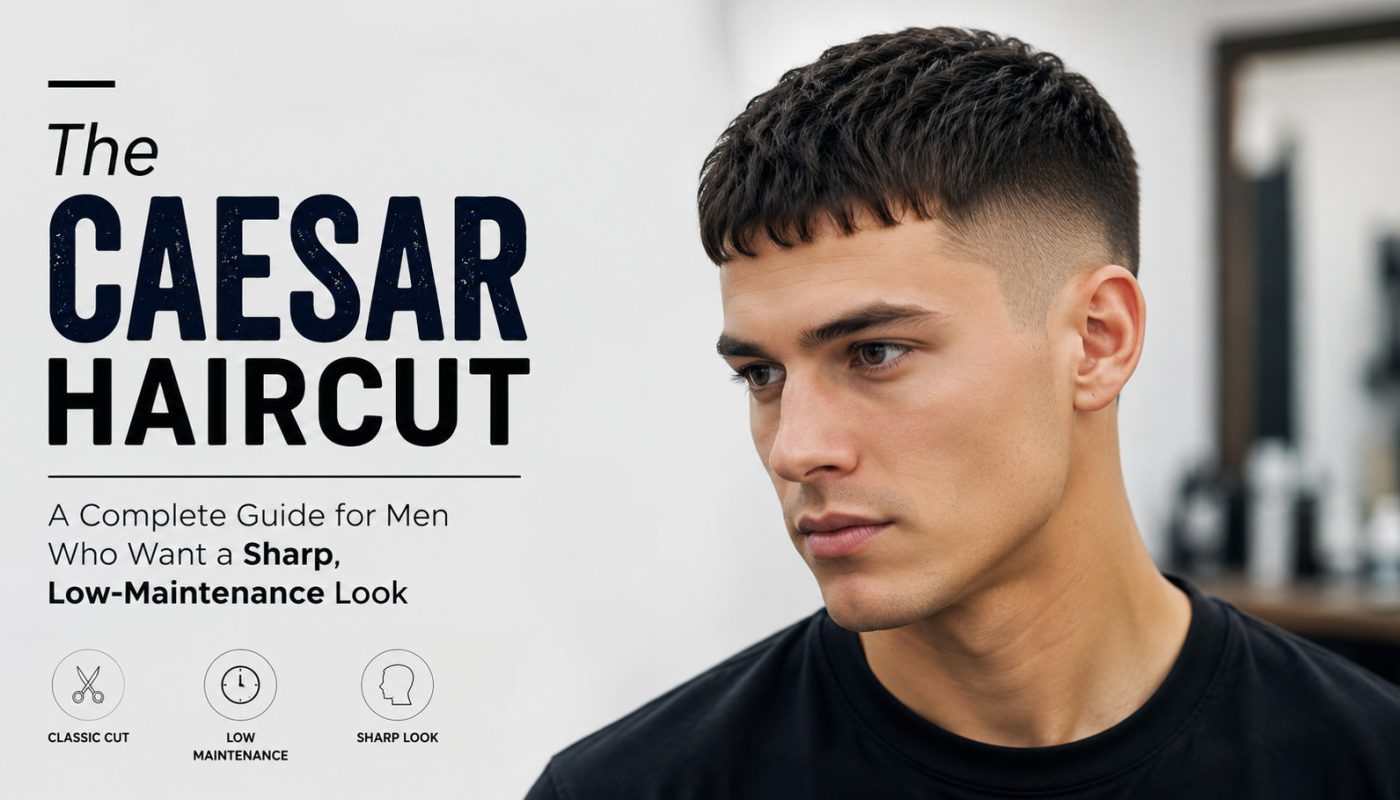
Caesar haircut is a moderately short men’s cut that has a straight side parting down the center of the forehead, and the hair is cut evenly from 1/2 inch to 2 inches. The sides and rear are also cropped off, sometimes tapered or faded, to give it a nice compact look.
They are named after the Roman emperors who were often shown with their hair combed forward like this. It is known as the Julius Caesar, and that’s where Julius Caesar fits in. It became even more popular in the 1990s when it was donned by film stars like George Clooney on the screen and has never been forgotten since then.
The difference lies in the fringe something you won’t get with a regular crop or crew cut haircut. The signature is the front bang. If not, it’s simply a shortcut. It makes a Caesar.
Why Men Still Choose the Caesar Cut Today
This style has remained popular for a long time for several practical reasons.
It’s suitable for thinning hair. The fringe is positioned forward on the forehead, which provides natural coverage of the initial stages of a receding hairline. A lot of men who see their hairline receding opt for this cut because of this.
Needs virtually no styling. A quick comb forward, perhaps a little clay or pomade, and that’s it. No blow-drying regimen or complicated layering to handle.
It works well for all hair types. This cut looks great on both straight, wavy, curly, and coily hair, but the resulting style will be slightly different for each of these textures.
It’s suitable for nearly any location. This cut does not look out of place in any of the following scenarios: job interview, marriage, casual weekends.
Popular Caesar Men’s Hairstyles
Not all Caesar cuts are alike. Over the years, barbers have modified the original shape to suit various hair lengths, textures, and individual styles. Below are the variations you are most likely to see or ask for.
Classic Caesar

This is the first edition. Short, even hair length and a blunt fringe that is cut across the forehead. Sides are tapered, not faded, for a clean but understated look. If you want something traditional, but without the frills, this is the version to inquire about.
Caesar Fade
The sides and back are trimmed in a fade, while the top is kept short with a forward fringe. The fade may be low, mid, or high, depending on the amount of contrast desired. This one is more likely to be more contemporary and will suit younger men or those who wish to add a little more edge.
Textured Caesar
The hair is cut using texturizing shears or a matte product to create separation and movement, rather than being cut and combed in a uniform way. The fringe could be a little ragged or not end up being perfectly square. This is a variation that looks great in photos and is ideal for men with thick hair.
Long Caesar

The top is slightly longer than the traditional version, allowing for a more elongated fringe to be pulled up and over or to the side. It looks great with a low or mid fade, and it offers a little more variety from day to day as you can push the fringe in various directions!
Curly Caesar
The Caesar is a cut for men who have a natural curl or coil, so that the top of the head shows off the curl and the sides are short and tidy. This version doesn’t fight with the hair’s natural texture, making maintenance easy.
Caesar with Beard

A well-groomed beard works well with this style, as it complements the short, neat top. It will help to create a more cohesive and intentional aesthetic, as opposed to appearing like two unrelated styles glued together.
How to Ask Your Barber for a Caesar Cut
If you don’t know the right words when you enter a barbershop, you may get a close haircut, but not quite the one you’re looking for. Here are some tips for getting your point across.
If you are going to a barbershop, let him know you want a Caesar cut, and your fringe should be straight and forward. State the length of the sides (taper or fade guard number). Take a picture with you if it is stored on your cell phone. Barbers work better from a visual interpretation rather than a description, as the word “short” can have different meanings to different people.
Also, keep in mind your hair type and any issues you have, such as a receding hairline or a cowlick, to help your barber cut your hair to fit your strands, not fight them.
How to Maintain the Look Between Visits
The low-maintenance aspect of this cut is one of the biggest advantages, but there are a few small habits that will ensure it looks sharp.
Wash and towel-dry hair and comb or brush the fringe forward while it is still damp. A little matte clay or light pomade will keep the shape and won’t give it a greasy appearance. Don’t use heavy gels, as they will squash the fringe and give it a stiff, unnatural appearance.
Trim every 3 4 weeks. The sides are cut short, so that growth is more apparent than in a longer cut. If you have a fade, you’ll probably need to go even more frequently to maintain the blend.
Who This Haircut Works Best For
The fringe complements the oval, square, and diamond face shapes well, as it balances out the forehead in the Caesar cut suits. It can also be worn by people with round faces, but adding some height on top with texture helps to prevent a flat look.
For men experiencing early hair loss, it’s a solid choice as it offers natural coverage without the need for a longer, more intricate haircut. It’s also good for those who just want an intentional, but not too time-consuming cut each morning.
Conclusion
This is why the Caesar haircut has survived this long: it’s a real issue that it’s solving. It’s fashionable, elegant, easy to maintain, and is suitable for nearly all hair and facial types. No matter if you take the traditional or contemporary fade, the essence of the style is short hair, forward fringe, and a clean, non-overdone finish.
Once you are ready to try, you can take a reference photo with you at the next barbershop visit and let your barbershop teacher know what position you want the fade or taper to be on the sides of your photo. A good barber will take over and assist you in finding the one that fits you and your face shape.
Frequently Asked Questions
Is the Caesar haircut still in style?
Yes. It’s been a constant favorite in barbershops for decades and is still requested frequently, particularly in faded and textured versions, which keep it fresh.
When should I have my Caesar haircut cut?
The vast majority of males come back every 3 4 weeks. If you have a fade in your version, you might want to fade in a little more often to keep sides sharp.
May I have a curly cut with a Caesar haircut?
Yes. This cut is actually very suitable for curly hair. The barber will usually leave more of your hair on top to maintain your natural curls while trimming the sides short and clean.